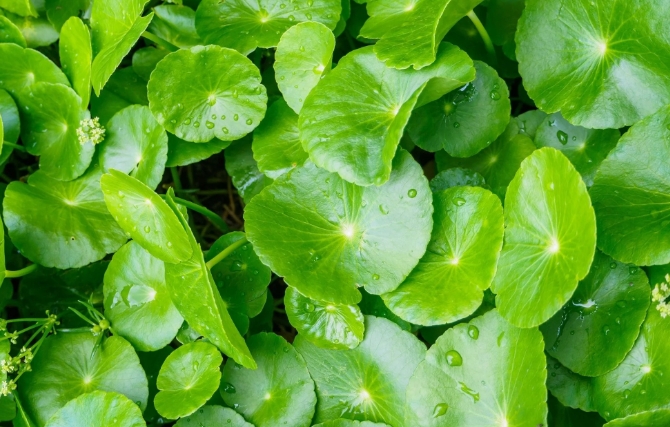
Centella Asiatica Extract, with its excellent repairing, soothing, and antioxidant properties, is a star ingredient in the fields of skincare, pharmaceuticals, and dietary supplements.
Where does Centella Asiatica Extract come from?
Centella Asiatica, also known as Tiger Grass or Gotu Kola, is native to tropical and subtropical regions of Asia, and is widely cultivated in Yunnan, Guangxi, and Hainan provinces of China. The source of the raw material directly determines the quality of the extract – wild Centella Asiatica has significant fluctuations in active ingredients, while standardized cultivation provides more traceable raw materials.
Standards for high-quality raw materials include:
Pure variety: Selecting strains with high total triterpene content
Harvesting time: Generally harvested before flowering, when the content of asiaticoside and madecassoside is at its peak
Pesticide residue control: Prioritizing planting bases that meet the standards of the Chinese Pharmacopoeia or USP
As a buyer, it is recommended to require suppliers to provide origin certificates and pesticide residue test reports, which is the first step in assessing the reliability of the raw materials.
Solvent extraction vs. supercritical fluid extraction: Which process is more suitable for large-scale production?
Currently, industrial production mainly uses two process routes:
1. Solvent extraction (mainstream process)
This is the most mature and cost-effective process, usually using water or an ethanol-water mixed system as the solvent:
Water extraction: Low cost and high safety, but relatively low extraction efficiency
Alcohol extraction: The highest total triterpene extraction rate is achieved when the ethanol concentration is 60%-70%
Macroporous resin purification: A key step that removes impurities and enriches active ingredients
2. Supercritical CO₂ extraction
Although the equipment investment is high, it has unique advantages:
No solvent residue, conforming to the "Clean Beauty" trend of high-end cosmetics
Low-temperature operation protects heat-sensitive components
The extract has a lighter color and a purer scent
B2B purchasing advice: For conventional skincare product ingredients, the solvent method is sufficient; if targeting high-end cosmeceuticals or organic certified products, the supercritical extraction process offers more premium value.
What total glycoside content of Centella asiatica extract is considered high-quality?
Total triterpenes 10%-40%: Ordinary cosmetic grade
Asiaticoside + Madecassoside ≥ 90%: High-purity pharmaceutical grade
TECA (Total Centella Asiatica Glycosides) customized preparations: European Pharmacopoeia standard
The content detection method must be clearly defined – using HPLC-ELSD method to determine the content of monomeric glycosides is more accurate and reliable than simple UV spectrophotometry. It is recommended that the detection method and standard source be clearly specified in the procurement contract.
It is worth noting that the efficacy of Centella asiatica extract depends not only on the total glycoside content, but also on the ratio of the four main triterpenic acids (asiatic acid, madecassic acid, asiaticoside, and madecassoside). Clinical studies have shown that the best repair effect is achieved when the four components work synergistically.
How is Centella asiatica extract applied in end products?
Application Areas | Recommended Specifications | Efficacy Positioning
Repairing Skincare Products | Total Triterpenes 70%-90% | Promotes collagen synthesis, repairs skin barrier
Sensitive Skin Care | Hydroxyasiaticoside Monomer | Anti-inflammatory and soothing, reduces redness
Functional Foods | Food-grade Total Glycosides 40% | Improves microcirculation, cognitive health
Pharmaceutical Topical Preparations | European Pharmacopoeia TECA Standard | Wound healing, scar repair
Formulation Suggestions: Centella Asiatica extract works synergistically with ingredients such as ceramides, panthenol, and β-glucan. The formula pH is recommended to be controlled between 5.0-6.5 to maintain ingredient stability.
Recommended High-Quality Raw Material Supplier
If you are looking for a stable supply source of Centella Asiatica extract raw materials, Xi'an Sost Biotech Co., Ltd. is a partner worth considering.
As a professional manufacturer with many years of experience in the field of plant extraction, Sost Biotech possesses:
Standardized planting bases: Controlling raw material quality from the source
Advanced extraction technology: Dual capacity of solvent method and supercritical extraction
Complete quality control system: Equipped with precision testing equipment such as HPLC and GC, providing detailed COA for each batch
Customized services: Supporting different specifications (10%-95% total triterpenes) and different packaging needs
International compliance support: Possessing a complete certification system required for export
Contact Information
Email: info@sostherbusa.com
For business inquiries and sample requests, please contact us directly via email.
Whether you need standard products for formula development or are seeking a stable supply of tons of raw materials, a professional supplier can provide solid technical and quality support for your business decisions.
References
Chinese Pharmacopoeia 2020 Edition, Part I, Standard for Centella asiatica
Park, Y. G., et al. (2020). "Centella asiatica-derived extracellular vesicles restore tight junctions in skin." Journal of Extracellular Vesicles, 9(1), 1806550.
National Pharmacopoeia Commission. (2020). Research on the Quality Standard of Centella asiatica Extract
James, J. T., & Dubery, I. A. (2011). "Pentacyclic triterpenoids from the medicinal herb, Centella asiatica (L.) Urban." Molecules, 16(2), 1310-1333.


Any questions or suggestions?
We are here to help with whatever you need.


Copyright © Sost Corporation Co.,Ltd. All rights reserved.


