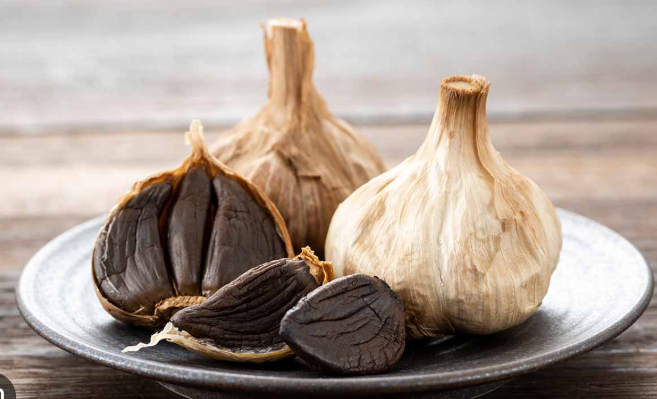
You may have come across the claim that "black garlic is the 'gold standard of garlic'," but how exactly is it better than regular garlic? Can eating it really relieve fatigue and protect the stomach? Will it irritate the stomach like regular garlic? Today, we'll explain the underlying logic of black garlic's effects, its practical uses, and its contraindications and precautions. After reading this, you'll understand how to eat black garlic effectively and when you should absolutely avoid it.
The core nutrient in regular garlic extract is allicin, but it has a fatal flaw—it's unstable. When exposed to heat, light, or air, it quickly breaks down into inactive substances, and it's highly irritating to the gastrointestinal mucosa. Many people experience acid reflux and stomach pain after eating it.
Black garlic's extract advantage comes from the modification of the fermentation process: fresh garlic is fermented in an environment of 60-70℃ and over 80% humidity for 20-30 days. Allicin is converted into S-allyl cysteine (SAC)—this substance is 10 times more stable (it stays in the body longer), and its irritancy is reduced by 90%, making it suitable even for people with sensitive stomachs.
At the same time, fermentation also produces polyphenolic compounds (three times higher than in regular garlic) and flavonoids, which are natural antioxidants.
Simply put, the "health benefits" of black garlic are essentially due to fermentation transforming the "disadvantages" of regular garlic into "advantages"—preserving the nutrients of garlic, eliminating the irritation, and adding more easily absorbed active ingredients.
Based on the nutritional upgrades brought about by fermentation, the effects of black garlic perfectly address the high-frequency health needs of modern people, each corresponding to specific scenarios in daily life:
1. A "fatigue-fighting miracle" for those working overtime: More effective than energy drinks in relieving muscle soreness.
Have you ever experienced this? Working overtime until midnight, even without doing physical labor, you feel shoulder pain and a heavy head, and drinking energy drinks only makes you feel more anxious.
The SAC in black garlic can promote the liver's metabolism of lactic acid—this "fatigue substance" is the culprit behind muscle soreness and mental fatigue. Studies show that eating one clove of black garlic daily for 3 consecutive days can reduce post-exercise lactic acid levels by 25%. A friend in the new media industry tested it: eating one clove after working until 11 pm was more effective than drinking iced coffee in relieving the feeling of "brain fog," and it didn't cause insomnia.
2. A "Garlic Alternative" for those with Sensitive Stomachs: Gentler on the stomach than regular garlic
Many people want the antibacterial benefits of garlic, but experience acid reflux after eating it. Black garlic has 30% lower acidity than regular garlic, and its S-allyl-cysteine (SAC) can promote gastric mucosal repair – making it a good compromise for those who want to eat garlic but have sensitive stomachs. For example, people with chronic gastritis can eat one clove of black garlic daily to get the nutritional benefits of garlic without irritating the gastric mucosa like regular garlic.
3. A "Blood Sugar Control Aid" for Diabetics: Helps stabilize post-meal blood sugar
The dietary fiber and active peptides in black garlic can slow down the absorption of glucose in the intestines – animal studies have shown that diabetic mice who consumed black garlic for 4 weeks had an 18% decrease in post-meal blood sugar peaks. However, it's important to note that this is an auxiliary effect and cannot replace blood sugar-lowering medication. Diabetics can eat black garlic as a snack, one clove a day, which is healthier than eating biscuits.
4. An "Immunity Booster" for those prone to colds during seasonal changes: More practical than Vitamin C
The SAC in black garlic can activate immune cells (such as macrophages), enhancing the body's ability to fight viruses. For example, people who are prone to colds during seasonal changes can eat one clove of black garlic daily to improve the resistance of their nasal mucosa – this doesn't mean they won't catch a cold, but the symptoms of nasal congestion and sore throat will be milder, and they will recover faster.
Even though black garlic is generally well-tolerated, it's not suitable for everyone. The following three types of people should avoid it, as it may worsen their symptoms:
1. People with eye diseases: May worsen dry eyes and eye pain
Many people think that because black garlic isn't "spicy," it's safe to eat, but it still retains a small amount of allicin. This substance stimulates the trigeminal nerve in the eyes. If you have glaucoma, conjunctivitis, or dry eye syndrome, eating too much can cause eye redness and dryness to worsen.
I met a glaucoma patient who ate three cloves of black garlic every day because he heard it could lower blood pressure. His eyes became red and swollen for a week, and he only found out at the hospital that it was due to the allicin.
2. People with excessive stomach acid/gastric ulcers: May "burn" the stomach
Black garlic is a weakly acidic food (pH value of approximately 5.0), and the fermentation process also produces a small amount of organic acids. If you already have excessive stomach acid secretion (e.g., frequent acid reflux, stomach pain), eating black garlic can worsen the erosion of the gastric mucosa – in severe cases, it may induce gastric ulcers and bleeding.
3. People currently taking "anticoagulant medications": May increase the risk of bleeding.
The SAC in black garlic enhances the effect of anticoagulant medications (such as warfarin). If consumed simultaneously, it slows down blood clotting, easily leading to gum bleeding, nosebleeds, or even internal bleeding. For example, patients who have undergone cardiac stent surgery should absolutely avoid black garlic.
Since the benefits of black garlic depend on proper consumption, how can you eat it without wasting its nutrients? The key is to avoid three common misconceptions:
1. The quantity should be "small": 1-2 cloves a day is just right, don't overdo it.
Black garlic is highly nutritious, but it is still "garlic." Eating 1-2 cloves a day (about 30-50 grams) is enough – eating too much can cause a sticky feeling in the mouth and acid reflux in the stomach, counteracting the health benefits. For example, eating one clove with millet porridge in the morning can provide nutrients without irritating the stomach; eating one clove during overtime work at night is healthier than drinking energy drinks.
2. The pairing should be "mild": Don't eat it with spicy or greasy foods.
Black garlic has a sweet and sour taste with a fruity aroma. If paired with spicy foods like hot pot or barbecue, it will increase the burden on the digestive system – for example, eating black garlic with hot pot is equivalent to "double stimulation," easily causing stomach pain. The best pairing is with mild foods: with millet porridge, boiled corn, or sandwiched in steamed buns, which can neutralize the acidity and allow for better nutrient absorption.
3. Choose "high-quality black garlic": Don't buy "fake fermented" black garlic.
The black garlic on the market is mixed in quality;
Choosing the right one is essential:
Look at the color: High-quality black garlic is dark brown, like ripe chestnuts; if the color is light yellow, it means the fermentation time was insufficient.
Feel the texture: It should be soft and elastic when squeezed, but not mushy – if it crumbles easily, it means it's over-fermented, and the nutrients have been lost.
Smell the aroma: It should have a light fruity or honey-like aroma, without a pungent odor; if it smells sour or moldy, absolutely do not buy it. Ultimately, black garlic isn't a "miracle cure," but rather a helpful aid for daily health – it can indeed provide support for minor issues such as fatigue from working overtime, a weak stomach, and susceptibility to colds during seasonal changes.
Black garlic extract manufacturer - Sost Biotech
Contact Email:ericyang@xasost.com


Any questions or suggestions?
We are here to help with whatever you need.


Copyright © Sost Corporation Co.,Ltd. All rights reserved.


