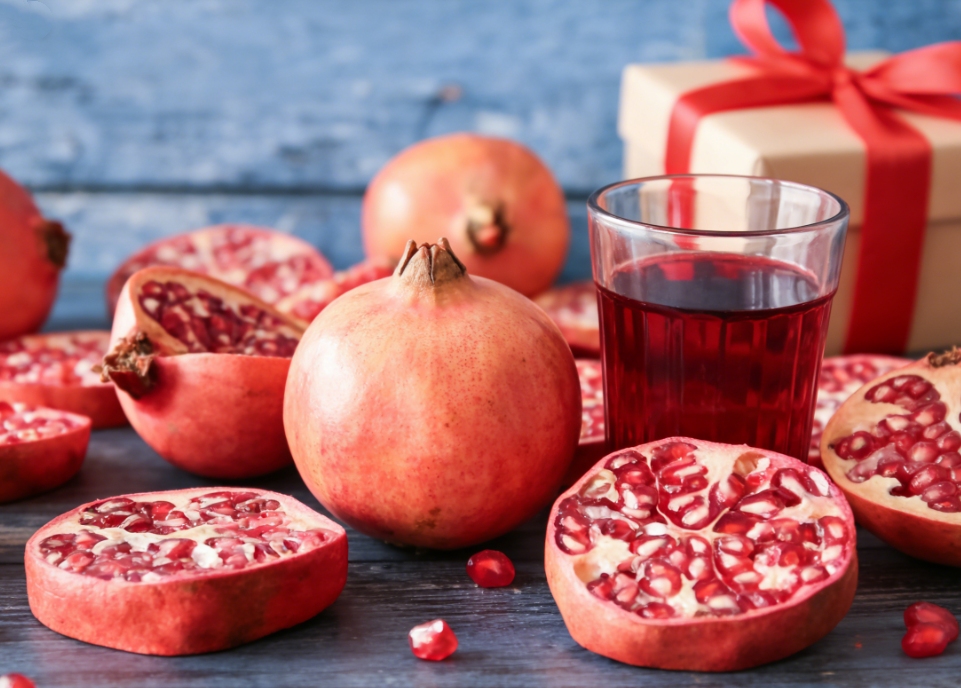
In today's booming health food ingredient market, pomegranate, as a representative of "superfruit," has seen its processing form become a focus of attention for many food, health product, and cosmetic companies. When searching for pomegranate raw materials, have you ever wondered: are pomegranate powder and pomegranate juice the same? These two seemingly similar products are vastly different in B2B applications.
Process Differences and Production Adaptability
Pomegranate Juice Production Process and Industrial Adaptation Scenarios
Pomegranate juice production follows the traditional fruit and vegetable juice processing route, with three key steps in the core process. First is pressing extraction, using screw pressing or pneumatic pressing technology to separate the juice from the pomegranate seeds. This step typically yields 60% to 75% juice, while also generating a large amount of fruit pomace waste. Next is filtration and clarification, removing suspended solids through enzymatic hydrolysis, centrifugation, and ultrafiltration to obtain clear or cloudy juice. However, this process results in the loss of some dietary fiber and polyphenols. Finally, sterilization and filling are performed using pasteurization (85-95℃) or UHT ultra-high temperature instantaneous sterilization (135-150℃), combined with aseptic or hot filling processes. The sterilization intensity directly affects the degree of flavor retention.
From an industrial adaptation perspective, pomegranate juice has several significant drawbacks: strong reliance on cold chain, resulting in high transportation and storage costs; short shelf life, only 30 to 45 days under refrigeration and 6 to 12 months at room temperature; large packaging volume, leading to high storage space occupancy; and significant seasonal production characteristics, with raw material fluctuations easily affecting supply stability.
Key Points of Pomegranate Powder Production Process and Cost Control
The production of pomegranate powder represents the culmination of concentration technology, with the core being the precise control of "concentration plus drying." The low-temperature concentration stage employs vacuum concentration or membrane concentration technology, increasing the solids content of pomegranate juice to 40-60°Brix at a low temperature of 40-60 degrees Celsius. This low-temperature process maximizes the retention of heat-sensitive nutrients such as vitamin C and anthocyanins.
The choice of drying technology directly affects the quality characteristics of pomegranate juice powder. Spray drying is currently the most mainstream process, dispersing the concentrate into tiny droplets through an atomizer, which are then instantly dried upon contact with hot air. It is suitable for large-scale continuous production, and the resulting pomegranate powder has good solubility. However, careful control of the inlet air temperature (usually 160-180°C) is necessary to avoid excessive Maillard reaction. Freeze-drying pre-freezes the material to -40 degrees Celsius, then sublimates and dehydrates it under vacuum. This process perfectly preserves the color, flavor, and active ingredients of the pomegranate powder, but it has high energy consumption and low production capacity, making it suitable for high-end health product applications. Vacuum belt drying uses a medium-low temperature continuous drying method, striking a balance between cost and quality. The resulting pomegranate powder has uniform particles and excellent rehydration properties.
In terms of cost control, pomegranate powder has significant advantages. Regarding yield, approximately 10 to 15 kilograms of fresh pomegranates yield 1 kilogram of pomegranate juice powder, resulting in a high concentration ratio and significantly reducing transportation and storage costs. In terms of shelf life, it can last up to 24 months under sealed, light-proof conditions, minimizing inventory turnover pressure. Regarding packaging advantages, the solid form can be packaged in an inner aluminum foil bag and outer cardboard box, with logistics costs only one-fifth to one-eighth of those for fruit juice.
Is pomegranate powder really more nutritious than pomegranate juice?
In fact, the nutritional differences between the two mainly lie in three aspects: concentration, dietary fiber retention, and the stability of heat-sensitive components.
Concentration Difference: The Gap in Solid Content Pomegranate juice, as a direct-drinking product, has a solid content of approximately 12% to 15%, with concentrated juice reaching 65° Brix, but still containing over 40% water. Pomegranate powder, on the other hand, has a water content controlled below 5%, resulting in a highly concentrated concentration of active ingredients. Taking polyphenol content as an example, the total polyphenol content of high-quality pomegranate juice powder can reach 8 to 10 times that of pomegranate juice (on a dry basis). This means that in functional food formulations, adding 1% pomegranate juice powder can achieve the same concentration of active ingredients as adding 10% pomegranate juice, without diluting the product system.
Dietary Fiber: The Value of Whole Fruit Utilization During pomegranate juice processing, the peel and pomace are usually discarded, resulting in a significant loss of dietary fiber. Pomegranate powder, however, can be processed using a "whole fruit powdering" process, retaining the dietary fiber (up to 30% to 40%) from the peel in the product. For companies developing gut health products, meal replacement powders, or baked goods, the added value of dietary fiber in pomegranate powder is significantly higher than that in juice.
Nutritional Retention: Process Determines Quality Regarding vitamin C retention, freeze-dried pomegranate powder retains over 90%, spray-dried pomegranate powder retains approximately 70% to 80%, while juice, after UHT sterilization, retains only 50% to 60%. Regarding anthocyanin retention, pomegranate powder retains over 85% through low-temperature processing, while fruit juice is easily degraded during sterilization and storage. Punicin, a high-value polyphenol unique to pomegranate, exhibits better stability in pomegranate juice powder than in its aqueous solution form.
If your product emphasizes antioxidant, whitening, or cardiovascular health benefits, pomegranate powder offers greater stability in its active ingredients. For a fresher taste and convenient ready-to-drink option, fruit juice is a better choice.
Which products are pomegranate powder and pomegranate juice suitable for?
Application Scenarios and Compatibility Requirements of Pomegranate Juice
In the beverage processing field, pomegranate juice can be used in RTD (Ready-to-Drink) beverages, but requires the use of preservatives or aseptic cold-fill technology, posing significant challenges to shelf-life stability. NFC (Not From Concentrate) juice is positioned as a high-end product, requiring a complete cold chain, resulting in high channel costs. When used as a juice base for cocktails, sparkling water, etc., compatibility with other ingredients must be considered.
In terms of direct supply to the catering industry, pomegranate juice is mainly supplied to fresh juice shops and high-end restaurants for freshly prepared drinks, emphasizing its "freshness" selling point and placing extremely high demands on suppliers' cold chain delivery capabilities and timeliness.
As an ingredient, pomegranate juice can be used in cold food systems such as yogurt and ice cream, but the amount added is limited (affected by water activity); it can also be used in sauces and condiments, but requires high-temperature processing, resulting in significant loss of flavor substances. Overall, the high water content of pomegranate juice limits its formulation, poses a high risk of microbial control, and has poor stability in cross-regional supply.
Application Scenarios and Adaptation Requirements of Pomegranate Powder
In the solid beverage sector, pomegranate juice powder has wide applications. Instant powders can be combined with vitamin C and probiotics, focusing on skin whitening and gut health; sparkling powder can be combined with sodium bicarbonate and organic acids for instant, convenient, and fashionable consumption; meal replacement shakes can combine pomegranate powder with whey protein and dietary fiber to control calorie intake. The advantages of pomegranate powder are its low water activity, high microbial safety, and small volume, facilitating e-commerce sales and cross-border logistics.
In the health supplement and dietary supplement industry, pomegranate powder can be used in hard capsules or tablets, directly filling or granulating for precise dosage; it can also be used as the content of soft capsules, mixed with an oil matrix to protect fat-soluble active ingredients; it can also be reconstituted to make oral liquids, but the dissolution rate and clarity of the pomegranate juice powder must be considered. When selecting pomegranate powder raw materials, attention should be paid to low pesticide residues and qualified heavy metals to ensure compliance with health supplement raw material standards.
In the baking and complementary food ingredients industry, pomegranate powder can be used in baked goods, adding 2% to 5% to bread and biscuits to impart a natural pink color and fruity aroma, replacing artificial colorings; it can be used in infant complementary foods, added to rice cereal and fruit puree to provide natural fruit flavor and nutrition, requiring control of microbial indicators and allergens; it can also be used in functional snacks, such as energy bars and gummy coatings, enhancing the product's health premium. Technically, the particle size distribution of pomegranate juice powder (usually 80-200 mesh) affects the taste; ultrafine grinding can improve fineness but increases cost; due to its strong hygroscopicity, it needs to be used in conjunction with anti-caking agents (such as silica).
Key Differences in Application:
Form Adaptability: Pomegranate juice is primarily a liquid system, while pomegranate powder can be used in both solid and liquid forms, offering greater flexibility.
Dosage Control: Pomegranate juice is limited by moisture content, restricting its dosage; pomegranate powder allows for precise measurement and adjustable concentration of active ingredients.
Cost Accounting: Pomegranate juice has high transportation and storage costs, resulting in significant hidden expenses; pomegranate powder has lower overall usage costs and higher cost-effectiveness.
Product Innovation: Pomegranate juice suffers from severe homogenization, making differentiation difficult; pomegranate juice powder offers greater potential for dosage form innovation and stronger pricing power.
B2B Purchasing and Cooperation Tips:
Supplier Selection Core Indicators:
**Process Stability Assessment: It is recommended to conduct on-site inspections or video audits of the production workshop to confirm HACCP and ISO22000 certifications; understand the type of drying equipment (spray tower specifications, freeze dryer capacity) to assess its suitability for your needs; request production records for three consecutive batches to evaluate process reproducibility.
**Ingredient Testing Report Review Should Focus on Multiple Dimensions: Basic indicators include moisture, ash content, particle size distribution, and solubility; active ingredients include total polyphenols (Folin-Ciocalteu method), anthocyanins (pH differential method), and punicein (HPLC method); safety indicators include pesticide residues (GB 2763 full list), heavy metals (lead, arsenic, cadmium, mercury), and microorganisms (total bacterial count, coliforms, molds and yeasts); specialized tests include ORAC antioxidant value and cell-based efficacy evaluation (if applicable).
Regarding application technical support, reputable suppliers should be able to provide suggestions on compounding pomegranate powder, including synergistic or antagonistic effects with vitamins, minerals, and other plant extracts; provide sample preparation support to assist in resolving issues related to solubility, stability, and taste; and provide regulatory consultation to ensure that raw materials meet the food safety standards of the target market (such as FDA GRAS, EFSA, and the Chinese Health Food Raw Material Catalog).
Application-side Adaptation and Optimization Recommendations:
During the formulation development stage, accelerated stability testing of pomegranate powder should be conducted (40℃/75%RH, 3 months) to assess color and retention rate of active ingredients; stability under different pH conditions should be tested, with an acidic environment (pH 3.0-4.0) being most favorable for anthocyanin retention; microencapsulation technology should be considered to further improve the oxidative stability and flavor masking effect of pomegranate juice powder.
During the production scale-up stage, attention should be paid to the hygroscopicity of pomegranate powder, and the humidity in the production workshop should be controlled below 60%; a loss-in-weight feeder is recommended for the weighing process to improve accuracy; the static electricity problem of pomegranate juice powder should be monitored during the mixing process, and a small amount of oil or antistatic agent can be added.
Partnering with SOST Biotech to Obtain High-Quality Pomegranate Powder Raw Materials
After gaining a thorough understanding of the differences between pomegranate powder and pomegranate juice, choosing a reliable raw material supplier becomes crucial. Xi'an Sost Biotech Co., Ltd., as a professional manufacturer in the field of plant extracts, is your ideal partner for sourcing high-quality pomegranate powder.
Why Choose SOST Biotech's Pomegranate Powder?
Regarding sourcing control, raw materials are selected from premium pomegranate producing areas, ensuring the color and flavor of the pomegranate powder. A dual process of low-temperature spray drying and vacuum belt drying is employed, allowing for customized pomegranate juice powder with different solubility and particle sizes to meet customer needs. Whole-fruit extraction is available as an option, preserving dietary fiber and enhancing product added value.
Regarding comprehensive certifications, the product is certified by ISO9001, ISO22000, HACCP, HALAL, KOSHER, and more. Third-party testing reports (SGS, Eurofins, etc.) are available for the pomegranate powder products, and pesticide residues and heavy metals meet international export standards. Customized testing is supported, such as for specific polyphenol content and microbial limits.
Regarding ample production capacity, the company has its own standardized production workshop with an annual pomegranate powder production capacity of 500 tons, supporting bulk purchases. An overseas warehouse is located in Los Angeles, USA, allowing North American customers to enjoy localized and rapid delivery. Flexible MOQ (Minimum Order Quantity) settings support a smooth transition from pilot production to mass production.
In terms of application support, our experienced R&D team provides formulation suggestions for pomegranate juice powder applications, covering solid beverages, health supplements, and baked goods. We offer free samples and COAs (Certificate of Analysis), assist clients in completing supplier audits, and support in-depth cooperation such as joint applications and patent strategy to enhance clients' product competitiveness.
Contact us to start a collaboration:
Email: info@sostherbusa.com
Website: www.sosterb.com
Headquarters: Xi'an High-tech Zone, China
Overseas Warehouse: California, USA
Whether you are developing new functional foods or optimizing existing product formulations, SOST Biotech's high-quality pomegranate powder raw materials and professional technical services will be a solid support in your supply chain. Contact our sales team now to obtain free samples and detailed product information, and jointly explore the market potential of pomegranate raw materials!
References:
Zhang Lihua et al. Research progress in pomegranate processing technology [J]. Food Industry Technology, 2023, 44(12): 389-396.
China Chamber of Commerce for Foodstuffs and Native Produce. 2024
China Plant Extract Industry Development Report [R]. Beijing, 2024. Seeram NP, et al.
Pomegranate juice and extract polyphenols inhibit LDL oxidation [J]. Atherosclerosis, 2020, 195(2): e179-e185.
National Center for Food Safety Risk Assessment. Interpretation of Food Safety Standards for Pomegranate Extract [S]. 2022.


Any questions or suggestions?
We are here to help with whatever you need.


Copyright © Sost Corporation Co.,Ltd. All rights reserved.


