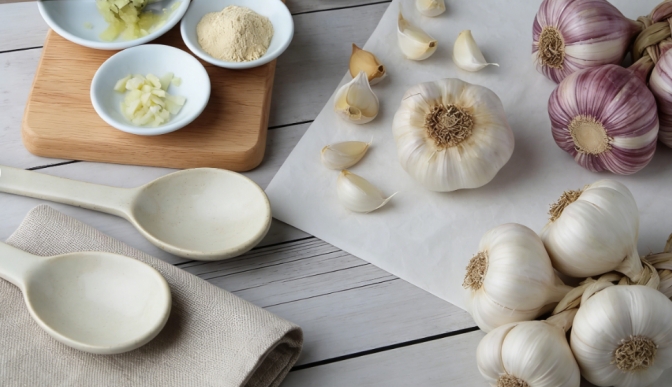
Basic Principles of Allicin Extraction
Allicin powder is one of the most important bioactive components in garlic, and is known as a "natural antibiotic." This miraculous compound does not exist directly in intact garlic, but is produced when garlic tissue is damaged, through the catalytic action of alliinase on alliin.
The formation of allicin is a classic enzymatic reaction: when garlic is chopped, crushed, or subjected to other forms of mechanical damage, the cell structure ruptures, allowing the previously separated alliin and alliinase to come into contact. Under suitable temperature and pH conditions, they react rapidly to produce allicin. This process explains why intact garlic has almost no strong garlic odor, while chopped garlic releases a strong, pungent aroma.
Detailed Explanation of Mainstream Extraction Technologies
2.1 Traditional Steam Distillation Method
Steam distillation is the earliest classic method used for allicin extraction. This process involves heating chopped garlic with water, using steam to carry out the volatile allicin, and then separating the garlic essential oil through condensation. This method is simple and inexpensive, but has significant limitations: high temperatures can destroy some of the allicin's activity, the extraction rate is relatively low, and the product may contain other volatile impurities.
2.2 Organic Solvent Extraction Method
The organic solvent extraction method uses polar solvents such as ethanol and methanol to extract the active components from garlic at lower temperatures. The advantage of this method is that the extraction conditions are mild, which can better preserve the biological activity of allicin. By optimizing extraction parameters (such as solvent concentration, extraction temperature, and time), the allicin extraction rate can be significantly improved. Studies have shown that using the ethanol extraction method, the allicin extraction rate can reach its optimal level under enzymatic hydrolysis temperature of 35℃, extraction temperature of 45℃, and extraction time of 2 hours.
2.3 Supercritical CO2 Extraction Technology
Supercritical CO2 extraction technology represents the most advanced level of allicin extraction currently available. This technology utilizes the special properties of carbon dioxide in its supercritical state (temperature above 31.1℃, pressure above 7.38 MPa) to selectively extract the active components from garlic. Supercritical CO2 possesses liquid-like solubility and gas-like diffusivity, enabling efficient extraction of heat-sensitive components at low temperatures.
The advantages of supercritical CO2 extraction of allicin are significant: low extraction temperature (usually 35-45℃), maximizing the preservation of allicin activity; no solvent residue, resulting in high product safety; integrated extraction and separation process, making the process simple and efficient; and high product purity, reaching pharmaceutical grade standards. Currently, low-temperature supercritical enzymatic hydrolysis extraction technology is internationally recognized as the most advanced and mature technology for garlic preparation.
2.4 Emerging Extraction Technologies
In recent years, some emerging technologies have also begun to be applied to the field of allicin extraction. Microwave-assisted extraction technology uses microwave radiation to accelerate cell rupture and improve extraction efficiency; ultrasonic-assisted extraction enhances solvent penetration through cavitation effects; and enzyme-assisted extraction improves the release rate of target components by adding specific enzyme preparations. These new technologies are often combined with traditional methods to form composite extraction processes, further improving the extraction effect of allicin.
Allicin Detection and Quality Control
Accurate detection of allicin powder bulk content is a key step in ensuring product quality. Currently, high-performance liquid chromatography (HPLC) is the gold standard for quantitative analysis of allicin. The 2020 edition of the Chinese Pharmacopoeia clearly specifies the HPLC detection method for allicin: using octadecylsilane-bonded silica gel as the stationary phase, methanol-0.1% formic acid solution (75:25) as the mobile phase, and a detection wavelength of 210 nm. This method requires that the theoretical plate number calculated from the allicin peak should be no less than 3000, ensuring the accuracy and reproducibility of the detection results.
Modern detection technologies also include liquid chromatography-mass spectrometry (LC-MS/MS), which offers higher sensitivity and specificity, enabling simultaneous detection of free and bound allicin, with a detection limit of up to 0.1 ppm. For allicin products used in different application scenarios, the testing standards also vary: the allicin content in fresh garlic is usually 0.3-0.8% (fresh weight); the allicin content in health supplements should be ±10% of the labeled amount; and pharmaceutical-grade raw materials require an allicin purity of ≥90%.
Challenges and Solutions for Allicin Stability
The extreme instability of allicin is one of the main challenges facing its industrial application. Studies have shown that allicin almost completely decomposes after 20 hours at room temperature, and decomposes even faster when heated. This instability stems from its special chemical structure – containing unstable disulfide bonds, which are easily affected by temperature, pH, light, and other factors.
To address this problem, researchers have developed a variety of stabilization technologies. Microencapsulation technology significantly improves stability by encapsulating allicin in a wall material, forming a protective barrier; cyclodextrin inclusion technology utilizes the cavity structure of cyclodextrin to embed allicin molecules, protecting the active ingredient and improving its solubility; liposome technology constructs a phospholipid bilayer structure to encapsulate allicin within liposomes, achieving both controlled release and protection.
In addition, some studies have found that when allicin is combined with certain drug carriers, it can not only improve its stability but also enhance its antibacterial activity or extend its duration of action. These innovative technologies provide important support for the industrial application of allicin.
Hot Topic Discussion
5.1 In-depth Analysis of Allicin's Antibacterial and Antiviral Mechanisms
The powerful antibacterial and antiviral activity of allicin is one of its most noteworthy characteristics. The latest research shows that the minimum inhibitory concentration of allicin against Helicobacter pylori is only 2.0 mg/ml. Its mechanism of action mainly includes three aspects: firstly, allicin can bind to sulfhydryl enzymes in microorganisms, competitively inhibiting their activity and interfering with the normal metabolism of microorganisms; secondly, allicin can destroy the cell membrane structure of bacteria, leading to leakage of cell contents; thirdly, allicin can affect the formation of biofilms, preventing microbial adhesion and colonization.
In terms of antiviral activity, allicin shows a special inhibitory effect on enveloped viruses. Research has found that allicin may disrupt the viral envelope structure through its lipid-soluble properties, thereby inhibiting the virus's infectivity. In addition, allicin can activate immune cells such as macrophages and T lymphocytes, enhancing the body's ability to fight viral infections, and can interfere with the synthesis of viral RNA, inhibiting viral replication.
5.2 Innovative Applications of Allicin in Functional Foods
With the popularization of health-conscious consumption, the application of allicin in the field of functional foods has shown explosive growth. The global functional food market is expected to continue expanding at a compound annual growth rate of 8%, and as an important functional ingredient, the market demand for allicin is constantly increasing. In the field of oral dietary supplements, allicin accounts for 75% of the market share, with product forms including capsules, oral liquids, and chewable tablets. The core functions focus on immune regulation, cardiovascular health maintenance, and intestinal flora balance.
Innovative applications are constantly emerging: adding allicin to baked goods not only gives the products a unique flavor but also provides a natural antibacterial effect; adding microencapsulated allicin to beverages to develop garlic-flavored health drinks; combining allicin with probiotics to develop composite products with dual health benefits. These innovations not only enrich the product forms but also expand the application boundaries of allicin.
5.3 Prospects and Challenges of Allicin Industrialization
The global allicin market is in a rapid development stage. The global allicin market size reached US$6.5 million in 2025 and is expected to achieve significant growth by 2032. The Asia-Pacific region is the fastest-growing regional market globally, with an average annual compound growth rate exceeding 12%. China, with its advantages in garlic planting resources and cost advantages, has become a major global production and export base for allicin.
However, industrial development also faces many challenges. Fluctuations in raw material prices are the primary problem; the stability of the supply of high-quality garlic raw materials directly affects production costs; technical barriers are high, and the preparation technology of high-purity allicin (above 90%) is still in the hands of a few companies; product homogenization competition is serious, and low-purity products flood the market, affecting the overall profit level of the industry; international certification thresholds are high, and entering high-end markets in Europe and the United States requires meeting strict regulatory requirements. Future development trends indicate that high-purity customization will become mainstream, composite products of allicin and other active ingredients will be favored, and green extraction processes and sustainable development will become industry standards.
Choosing a Professional Allicin Manufacturer
Facing the growing market demand for allicin, choosing a professional and reliable manufacturer is crucial. Xi'an Sost Biotech Co., Ltd., as a leading enterprise in the plant extract industry, has significant advantages in the production of garlic extract allicin.
The company possesses modern large-scale supercritical CO2 extraction equipment, enabling efficient extraction and purification of allicin. Its allicin products have a purity of over 5%, fully meeting international pharmaceutical standards. The company has obtained multiple authoritative certifications, including ISO9001 quality management system certification, HALAL certification, and KOSHER certification, and its products are exported to more than 50 countries and regions in Europe, America, and Southeast Asia.
In terms of quality control, Xi'an Sost Biotech Co., Ltd. is equipped with advanced HPLC and LC-MS/MS testing equipment and has established a comprehensive quality management system. Each batch of products undergoes strict raw material inspection, process monitoring, and finished product testing to ensure stable and reliable product quality. The company can also provide authoritative third-party testing reports, including certifications from internationally renowned testing institutions such as SGS and BV.
For customers seeking high-quality allicin, Xi'an Sost Biotech Co., Ltd. provides flexible customized services, adjusting product specifications, purity, and packaging according to customer needs. The company's professional technical team can also provide customers with application technical support and product development suggestions.
For more product information or to request samples, please contact:
Email: info@sostherbusa.com


Any questions or suggestions?
We are here to help with whatever you need.


Copyright © Sost Corporation Co.,Ltd. All rights reserved.


